English
 Spanish
 Portuguese

HQY255-125 Busduct Busway Bridge Housing Extrusion Pressing Clamping MachineFeat
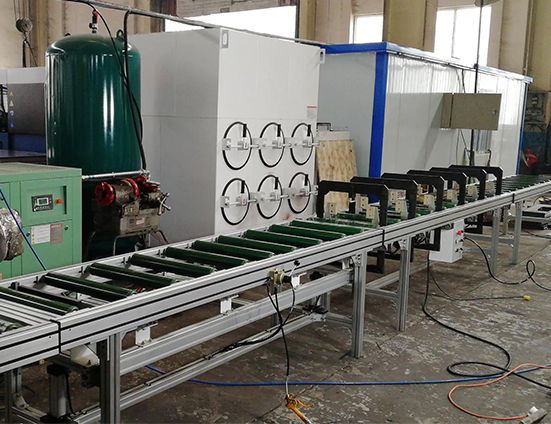
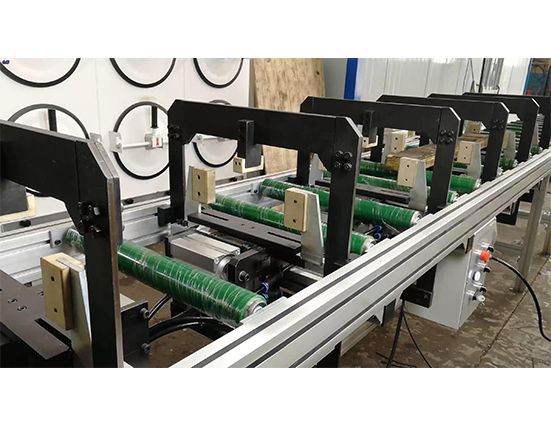
The HQY255-125 is the riveting station for busduct bridge housings, used where the joint is assembled by hand and needs the copper compacted before riveting. It handles busbar trunking from 91 to 255 mm in width and 125 mm in height, and is built around three tables: riveting, prefabrication and discharge. Clamping is pneumatic and the press is relay-controlled, with polyurethane-covered idle rollers that prevent scratching the bridge. The upper pressing device is a bolted 8 mm steel plate assembly guided by guide blocks. Operation is by foot switch, so the operator keeps both hands free for riveting.
Values per the model datasheet. Each paragraph is self-contained and states the test condition, the value and the comparison baseline.
Test condition: riveting and clamping busduct bridge housings before riveting. Value: covers busbar trunking from 91 to 255 mm width and 125 mm height, with 125 × 255 mm and 125 × 91 mm both supported. Comparison baseline: manual clamping with hand tools, which cannot apply a uniform pressure across the joint. Effect: one station covers the trunking width range with a single clamping sequence.
Test condition: pressing a pre-installed bridge into position before riveting. Value: pneumatic clamping on both sides combined with a downward pressing device, actuated by foot switch. Comparison baseline: manual clamping with clamps and vices, where the pressure depends on the operator. Effect: the copper is compacted uniformly before the operator rivets, instead of being squeezed locally.
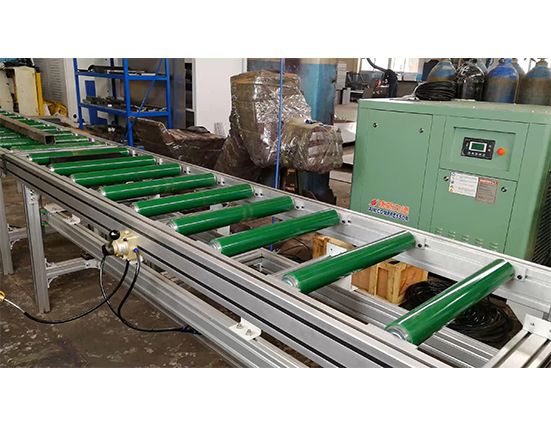
Test condition: moving the bridge across the machine on its rollers. Value: polyurethane-covered roller surfaces, on an integrated no-power roller arrangement. Comparison baseline: bare steel rollers, which mark and scratch the bridge as it moves. Effect: the housing surface reaches the riveting stage unmarked.
Test condition: a complete riveting cycle on the HQY255-125. Value: one foot switch sequence drives the lifting device, the two side clamps and the pressing device. Comparison baseline: manual sequences where the operator alternates between clamping tools and the riveting tool. Effect: both hands stay on the riveting work while the machine holds the bridge.
Busbar trunking from 91 to 255 mm in width and 125 mm in height, including both 125 × 255 mm and 125 × 91 mm.
Pneumatically on both sides, with an upper pressing device, all actuated from a single foot switch.
To prevent the roller surface from scratching the bridge housing while it is moved into and out of the pressing position.
HQY255-125 Busduct Busway Bridge Housing Extrusion Pressing Clamping Machine
Features:
1. Use and requirements:The busbar press is equipped with three parts: riveting table, prefabricated table and discharge table. It is used for riveting assembly of busbar row of 91 ~ 255mm width and height of 125mm. After the busbar row is installed, push the riveting table and press Will be targeted after the compression to facilitate the artificial riveting.
2. With relay control, pneumatic clamping, no power roller with integral installation, roller surface covered with polyurethane, to prevent scratching the bridge. The frame steel beam is formed by bending the steel plate and is supported by the steel pipe of the square pipe, which can be adjusted according to the need, the rack surface spray (gray). The upper pressing device is made of bolts with 8mm steel plate as a whole and guided by guide block. Work will be pre-installed bridge to the appropriate position, depress the foot switch, the top material device to lift the bridge from the roller in place after the remain intact, both sides of the clamping device action clamping the bridge, the last pressure Tight device action will be copper compacted. After the completion of artificial riveting, step down the foot switch, the pressure on the rise, both sides of the pressure release, the top material device down the bridge to fall back to the roller surface, the bridge pushed out to the discharge station for follow-up operation.
Bridge processing requirements:
1, the bus press for 125 × 255mm and 125X91mm between the specifications of the bridge, before the riveting clamping operation.
2, Pre-installed part of the pneumatic block on the device.
Technical support:
Busbar press machine instructions:
Including safety warning, machine principle, performance parameters, pneumatic schematic diagram, accessory table, wiring table, safe operating procedures.